“Please Don’t Touch My Baby” on Building Consent into a Child’s Life from Day One
Split Banana facilitator, Dan , shares their thoughts on how to weave consent into a child’s life from the very beginning.
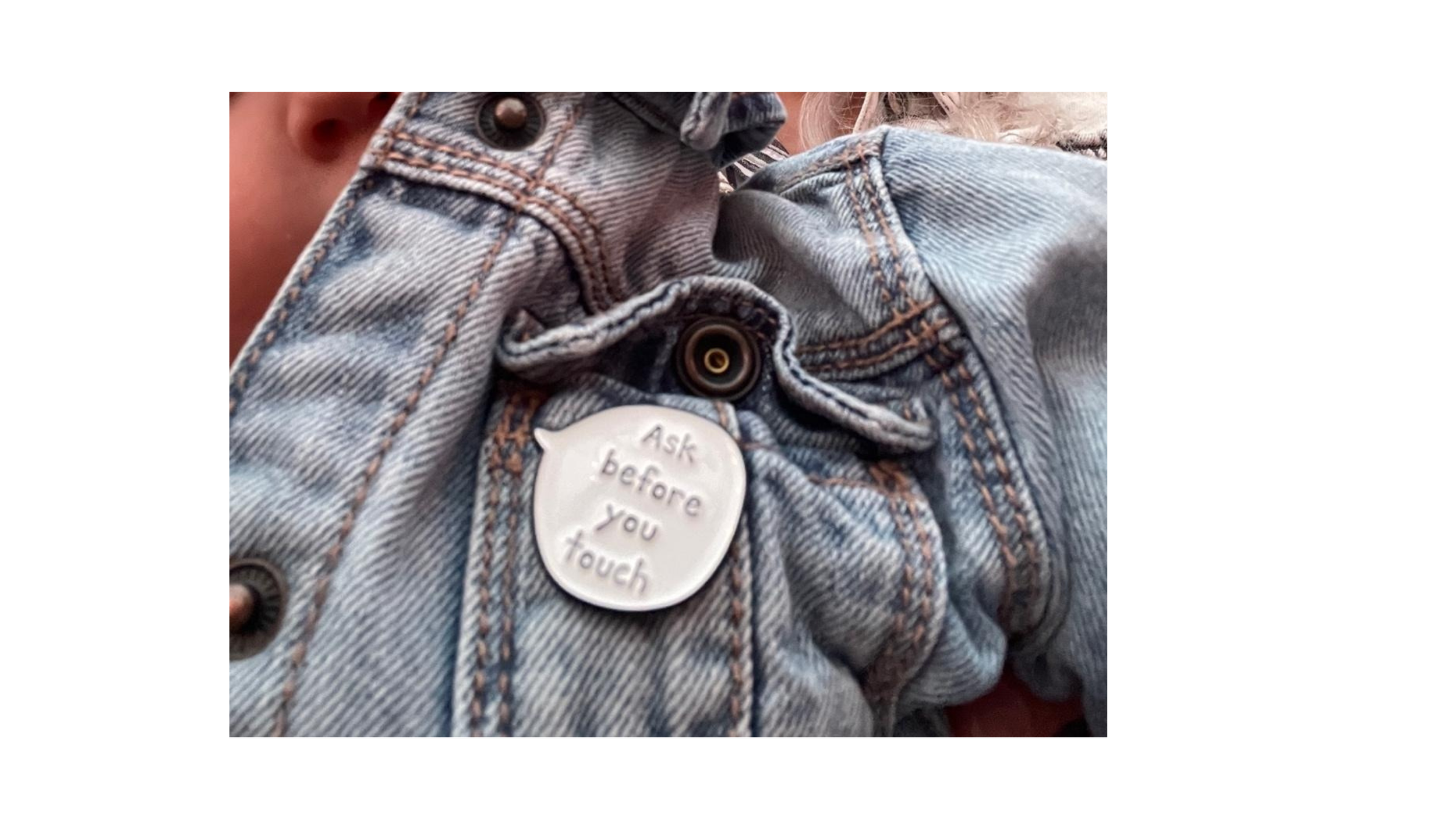
Not pictured: Mum and Dad also in denim jackets. Baby wore it best.
“Sorry – could you not touch my baby please?”
I feel a lurch in my chest as I say these words to a stranger, who has just started to stroke my baby’s cheek.
“Sorry,” I say again – now slightly annoyed at myself for feeling like I have to explain – “we only want people who know her to touch her.”
Fortunately, the person withdraws their hand and doesn’t seem annoyed at me. I breathe with relief, and move on.
I imagine a bubble around my baby: an invisible boundary that is her space in the world. Sometimes I can almost see it, that strong is my sense of her being her own person.
Those of us who are responsible for her – me, her Mum, family, friends, nursery workers – must come into this bubble in order to care for her. This is the flipside of children’s limited ability to consent: in return for not wholly choosing their boundaries and experiences, they are looked after by a society of adults – in principle, at least. For me right now in my relationship with my daughter, this takes the form of cuddling (wonderful), bathtime (really wonderful) and nappy changes (less wonderful).
And still: we are trying to do these things with a sense of consent. We give her a heads up about what we’re about to do, and speak about why we’re doing it. We show her we are nearby, and go gently into her space so it’s not a shock to her nervous system. I say trying: sometimes – despite being an educator in this sort of thing – it’s easy to slip into speedy functionality, and not give her the level of care I’d like to. Especially with nappy changes.
I imagine you have your own invisible bubble around you: your ‘personal space’. We might use the word ‘invade’ when this boundary is crossed – even accidentally – without our agreement: a strong word that has violence at its root.
This bubble stretches and contracts according to where you are, who you’re with, and how you’re feeling. On the tube at rush hour? It might be almost non-existent. Silently meditating? Might be a pretty big bubble – even someone coming to sit nearby may feel like a transgression.
Navigating these personal and sometimes overlapping bubbles is a delicate and difficult dance between adults, let alone when it comes to working with children and the inherent power imbalances between us. All this in a culture where consent is often understood poorly, and barely spoken about in an everyday sort of way.
When an adult stranger reaches out to touch my baby without asking me if it’s ok – something that happens surprisingly regularly – I breathe through my defensive reactivity. I try to understand, and know that they are not doing it with ill intent. They are seeking connection, and my job is to be both strong and kind: to articulate my child’s boundaries without seeking to shame for unthinkingly crossing them. This is a fierce kind of love.
My child can’t really comprehend these things yet – so why is this important now?
As she grows up, I want her to know that her body and personal space is hers, and for her to be confident and strong in articulating and showing her own choices. To say ‘no’, and to move away when something doesn’t feel good. My role is to reinforce and reassure her that this is ok, and that making sure she feels comfortable about what happens to her– even if it upsets someone else – may feel difficult, but is right.
This applies to all children of course, regardless of gender – though I worry that, as a girl, she will be exposed to messages that erode her sense of autonomy. This is why I love my role with Split Banana, working with young people to open up conversations and deepen understanding of consent. It’s vital work that aims to reduce harm and increase happiness for everyone.
I hope my daughter benefits from a broader and better understanding and navigating of consent as she grows up, and I’m not nearby or needed to support her boundaries.